
New Layout vs Established Neighbourhood: How to Weigh Growth Potential vs Liveability
Overview: How to Evaluate a Property Location
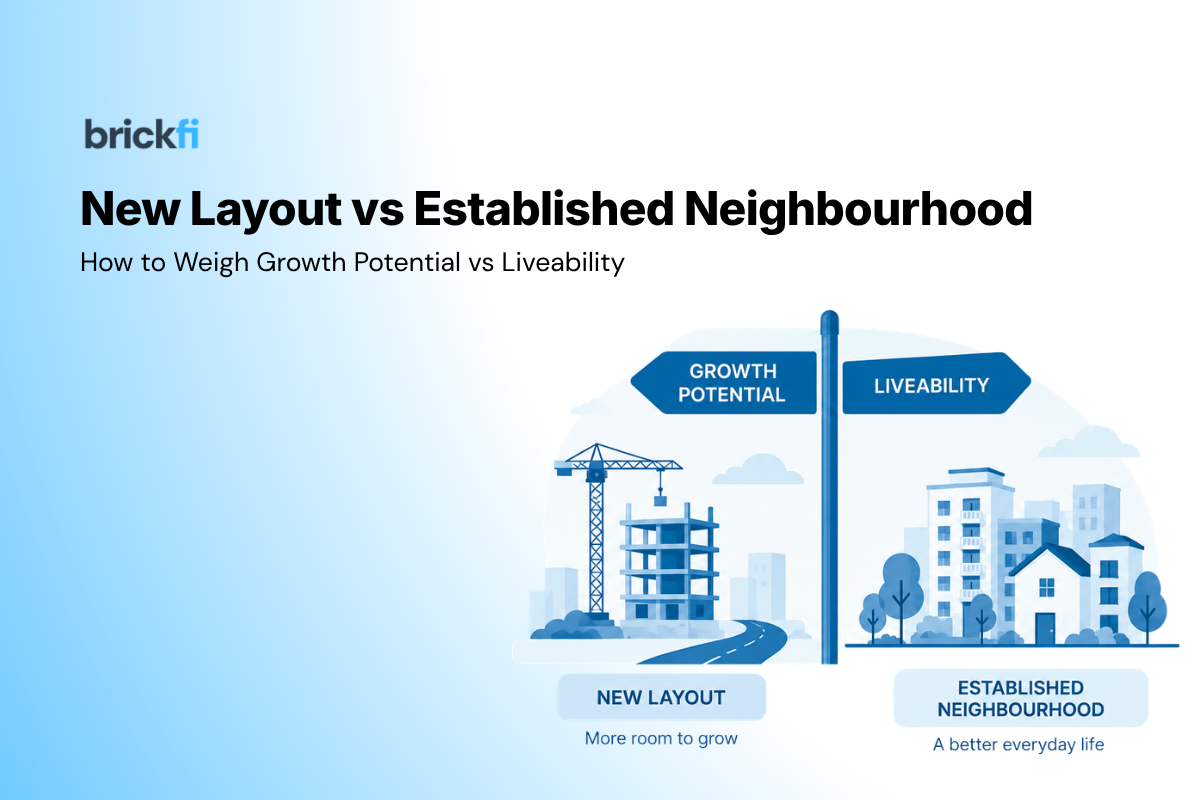
A new layout on Bangalore’s outskirts may offer a lower entry price, new infrastructure and room for appreciation. An established neighbourhood may cost considerably more but give you functioning roads, schools, hospitals, offices and everyday conveniences from day one. Neither is automatically the better property location.
The mistake is comparing the two only on today’s price. If you want to understand how to evaluate a property location, you need to separate what already exists from what is expected to arrive. Future infrastructure can improve accessibility and demand, but an announced metro line or proposed road is not the same as infrastructure you can use today.
This guide looks at how to balance growth potential with liveability, how infrastructure affects property prices, what to examine across Bangalore’s growth corridors and how to decide whether a developing or established location fits your reason for buying.
Key Takeaways
- New layouts can offer more growth potential, but that potential usually comes with greater infrastructure and execution risk.
- Established neighbourhoods generally provide stronger current liveability but often come with higher entry prices.
- Metro connectivity matters most when it meaningfully improves access to employment and established parts of the city.
- Evaluate actual and under construction infrastructure separately from projects that are only proposed or announced.
- The right location depends on whether you are buying for self use, rental demand, resale liquidity or long term appreciation.
Get instant access to expert, data-driven property insights.
Request your free Brickfi investment report now and make smarter real estate decisions today.
New Layout vs Established Neighbourhood: What Are You Actually Comparing?
A new layout or developing corridor is usually priced partly on what the area could become. Roads may be expanding, commercial development may be arriving and residential supply may still be growing. Buyers enter earlier, but they also take on more uncertainty.
An established neighbourhood gives you much more evidence. You can inspect current traffic, schools, hospitals, retail, public transport, rental demand and the general quality of the surroundings. The trade off is that much of this maturity may already be reflected in the property price.
How to Assess Future Growth of an Area
If you are buying in a developing location, future growth should be supported by multiple demand drivers rather than one promised infrastructure project.
Look at existing and upcoming office clusters, industrial zones, technology parks and major employment corridors. Then examine whether residential development is being supported by roads, public transport and social infrastructure.
When assessing future growth, focus on:
- Employment within a realistic commuting radius
- Major road and public transport improvements
- Schools, hospitals and retail that are already operational or under construction
- Residential and commercial development from multiple credible developers
- Rental demand and occupancy in nearby completed projects
- Current property prices relative to more mature neighbouring areas
This is a more useful way to understand how to assess future growth of an area than relying on a sales pitch built around one future metro station.
Brickfi’s own Bangalore analysis reflects this difference. It describes North Bangalore as having a longer growth runway tied to airport, logistics and commercial expansion, while East Bangalore’s housing demand is more closely linked with established technology employment. South Bangalore has deeper end user infrastructure in mature pockets, with peripheral locations developing as connectivity improves.
How Infrastructure Affects Property Prices
Infrastructure can change a location because it changes accessibility. A new road, metro connection or employment corridor can reduce travel friction and make an area practical for a larger group of buyers and tenants.
But how infrastructure affects property prices depends on more than the announcement itself. The market may price in major infrastructure long before completion. If a project is already selling at a substantial premium because of a proposed metro station, part of the expected benefit may already be reflected in the purchase price.
Separate infrastructure into three buckets:
- Operational: You can use it today.
- Under construction: Work has started, but completion and actual impact still need to be assessed.
- Proposed: It may improve the area in the future, but timing and execution remain uncertain.
This distinction matters enormously when comparing two properties. Paying today’s premium for tomorrow’s infrastructure only makes sense if the underlying location also has enough demand to support the price.
Get instant access to expert, data-driven property insights.
Request your free Brickfi investment report now and make smarter real estate decisions today.
How Much Should Metro Connectivity Matter?
Metro connectivity can strengthen a residential location when it connects people efficiently to workplaces, interchange stations and established parts of Bangalore. It can also expand the tenant pool for locations that were previously difficult to commute from.
But distance matters. “Near metro” can mean a comfortable walk, a short feeder ride or several kilometres through congested roads. Those are very different propositions.
When evaluating metro connectivity, check the actual station location, current project status, likely last mile access and whether the line connects conveniently to the places residents need to reach.
A metro line should improve an already understandable location thesis. It should not be the entire thesis.
North, East, South and West Bangalore: What Is Driving Growth?
Calling an entire side of Bangalore a “growth area” is not particularly useful. Each zone contains mature neighbourhoods, developing corridors and speculative pockets.
North Bangalore growth areas are largely influenced by the airport corridor, Hebbal and Yelahanka connectivity, logistics activity and expanding commercial development. The opportunity can be meaningful, but buyers should distinguish established northern micro markets from peripheral locations being marketed primarily on future growth. Brickfi’s existing regional analysis similarly notes that North Bangalore’s potential is highly pocket specific and sensitive to infrastructure timelines
East Bangalore emerging areas benefit from the broader employment ecosystem around Whitefield, Outer Ring Road and connected technology corridors. Established East Bangalore already carries substantial pricing in many locations, so buyers moving farther outward need to assess whether connectivity and social infrastructure are keeping pace with new residential supply.
South Bangalore emerging areas include peripheral corridors benefiting from employment around Electronic City and expanding transport connectivity. Mature South Bangalore, however, behaves differently because many established neighbourhoods already have strong end-user demand and social infrastructure.
For West Bangalore developing areas, the same framework should apply rather than assuming every western corridor has identical potential. Check employment access, transport, road capacity, social infrastructure and actual residential demand at the micro market level.
The best areas in Bangalore are therefore not one fixed list. Brickfi’s own location guide makes the same point: the appropriate area changes depending on whether the buyer prioritises end use, rental income or long term appreciation.
Which Is Better for Liveability: New or Established Areas?
If immediate quality of life is the priority, an established neighbourhood generally gives you more certainty. You can inspect the commute, roads, drainage, grocery access, schools, hospitals, parks and public transport before buying rather than estimating what they might look like several years later.
A developing area can still work well for an end user, particularly if the essential infrastructure already exists and the remaining development is incremental rather than fundamental. The real question behind Which Is Better for Liveability is therefore how much inconvenience you are willing to accept today for possible improvement tomorrow.
For self use, test the location like a resident rather than an investor. Visit during weekday peak hours. Check the route to work. Look at the nearest hospital and supermarket. See what the surrounding roads are like after dark. A location can have strong appreciation potential and still be frustrating to live in every day.
Get instant access to expert, data-driven property insights.
Request your free Brickfi investment report now and make smarter real estate decisions today.
How to Evaluate a Property Location Before Buying
A practical location assessment should combine current liveability with future demand rather than scoring either in isolation.
Start with four questions:
- What works today?
Check roads, workplaces, schools, hospitals, retail and public transport. - What is genuinely changing?
Verify major infrastructure and commercial projects instead of relying on developer timelines. - Who will want to live here later?
Identify the likely end users and tenants supporting future demand. - What am I already paying for that growth?
Compare the property’s price per square foot with nearby projects and more mature micro markets.
This is also where Brickfi’s approach fits naturally. Brick360 analyses location and surroundings alongside pricing and growth potential, using public and government data rather than treating future appreciation as a standalone promise.
How to Check Project RERA Number Before Buying in a Growth Corridor
Location potential should never distract from project level due diligence. Even if an area looks promising, verify the specific development before committing money.
If you are wondering how to check project RERA number, use the official Karnataka RERA records and search for the project or its registration details. Match the project name, promoter information and other available details with what the developer has provided.
RERA registration does not tell you whether the location is a good investment. It answers a different question about the project’s regulatory registration. That separation is important, just as the reference blog separates broker verification from wider property due diligence.
Growth Potential and Liveability Need to Be Judged Together
The strongest location is not necessarily the newest corridor or the most established neighbourhood. It is the one where the price you pay makes sense for the infrastructure, demand, liveability and future growth you are actually getting.
If you are buying for self use, current liveability deserves more weight. If your horizon is long and you can tolerate infrastructure still being built, a carefully selected growth corridor may offer a different opportunity. Either way, learning how to evaluate a property location means separating measurable facts from future promises.
At Brickfi, we evaluate property locations through factors such as surroundings, road connectivity, workplace distribution, pricing and growth potential. That gives buyers a way to compare locations on the factors that actually affect ownership rather than simply accepting whichever area happens to be called Bangalore’s “next hotspot.”
FAQs: How to Evaluate a Property Location
1. How to evaluate a property location before buying?
Assess current infrastructure, employment access, commute times, social infrastructure, property pricing, rental demand and future development. Compare what exists today with what is only proposed before deciding whether the asking price is justified.
2. How to assess future growth of an area?
Look for multiple demand drivers such as employment, transport infrastructure, commercial activity, social infrastructure and sustained residential demand. Growth based on several factors is easier to evaluate than growth dependent on a single proposed project.
3. How does infrastructure affect property prices?
Better infrastructure can improve accessibility and make an area attractive to more buyers and tenants. However, property prices may rise before infrastructure is completed, so buyers should check whether expected improvements are already reflected in the asking price.
4. Which is better for liveability, a new layout or an established neighbourhood?
Established neighbourhoods generally provide greater certainty around roads, schools, hospitals, retail and commuting. New layouts may improve significantly over time but can involve short term compromises while surrounding infrastructure develops.
5. What are the best areas in Bangalore for property buyers?
There is no single list of best areas in Bangalore for every buyer. The appropriate location depends on whether you prioritise self use, rental demand, resale liquidity or long term growth. Compare individual micro markets rather than choosing solely by region.
Get instant access to expert, data-driven property insights.
Request your free Brickfi investment report now and make smarter real estate decisions today.