
Questions to Ask a Broker That Reveal Whether They’re Working for You or the Builder
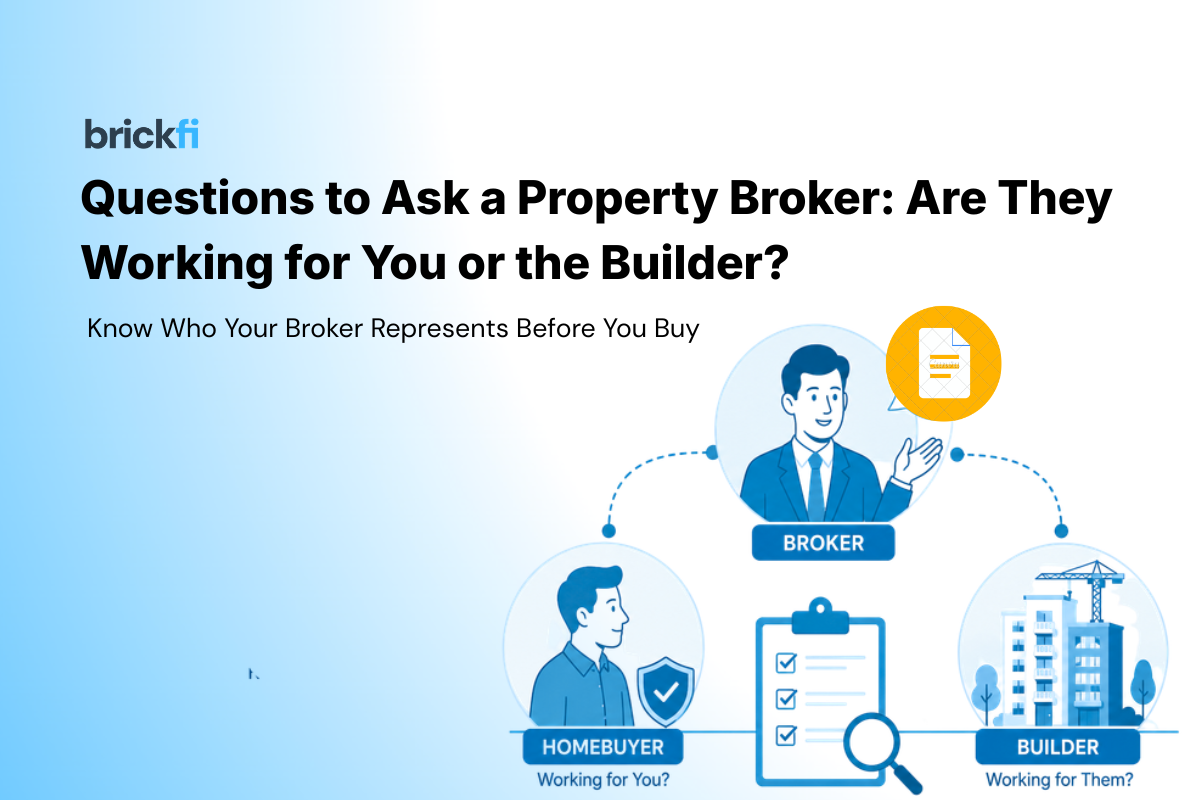
Overview: Questions to Ask a Property Broker
A property broker can make buying a home significantly easier. They can shortlist projects, arrange site visits, coordinate with builder sales teams and help with negotiations. But before relying on their recommendations, there is one thing every buyer should understand: who is the broker actually working for?
The answer is not always obvious. Some brokers work independently for buyers, while others operate as channel partners and receive commissions from builders when they close a sale. Neither arrangement is automatically a problem. What matters is whether the relationship is transparent and whether you understand what may influence the properties being recommended to you.
Asking the right questions to a property broker before buying can reveal how they are compensated, which builders they work with, whether their recommendations cover the wider market, and how much independent advice you are actually receiving.
Key Takeaways
- Ask who pays the broker before relying on their property recommendations.
- A broker working with a builder can still be useful, but the commercial relationship should be disclosed clearly.
- Buyers should ask whether the broker is showing the wider market or only projects where they earn a commission.
- For applicable transactions, verify whether the broker is a RERA registered agent.
- Good property advice should be supported by facts about the project, location and pricing rather than urgency or sales pressure.
Who Does a Real Estate Broker Actually Work For?
There is no single answer because property brokers operate under different business models.
An independent buyer-side broker may help a homebuyer search across the market and charge the buyer for the service. A resale broker may facilitate a transaction between an individual seller and buyer. A channel partner, meanwhile, may have formal arrangements with one or more developers and receive compensation when a buyer purchases through them.
The important distinction is between facilitating your purchase and representing only your interests.
A broker can provide useful assistance without being an independent buyer representative. Problems arise when the buyer assumes independence without understanding the commercial relationship behind the recommendation.
That is why the first conversation with a broker should establish their role before moving into projects and prices.
Get instant access to expert, data-driven property insights.
Request your free Brickfi investment report now and make smarter real estate decisions today.
1. Who Pays Your Commission?
This should be one of the first questions to ask a property broker.
Ask directly:
“Who pays you if I buy this property?”
The answer tells you how the commercial relationship works.
For some new projects in Bangalore, developers appoint channel partners and compensate them for successful sales. In resale transactions, brokerage may be paid by the buyer, seller or both depending on the arrangement.
There is no universal brokerage structure that applies to every transaction. What matters is transparency.
If the builder pays the broker, you should know that before evaluating the recommendation. If you are expected to pay brokerage, ask about the amount, when it becomes payable and what services are included.
A professional broker should be comfortable explaining this clearly.
2. Are You Working for Me, the Builder, or Both?
Who pays the commission leads naturally to the next question.
A broker may be helping you find a home while simultaneously having a commercial arrangement with the developer selling that home. That does not automatically make the advice unreliable. But it does change how you should interpret it.
If the broker is a builder channel partner, their role may involve:
- Marketing the developer’s projects
- Generating qualified buyer leads
- Arranging site visits
- Explaining available inventory
- Coordinating with the builder’s sales team
- Helping move the transaction towards closure
That is different from someone independently assessing the entire Bangalore market exclusively from your perspective.
Ask the broker to define their role clearly. A straightforward answer gives you useful context for everything that follows.
Get instant access to expert, data-driven property insights.
Request your free Brickfi investment report now and make smarter real estate decisions today.
3. Do You Work With Every Builder or Only Selected Projects?
A property search can appear broad even when the broker is working with a relatively limited inventory.
Suppose you ask for a 3 BHK in East Bangalore and receive five project recommendations. Those may genuinely be suitable options, but you still need to know whether they were selected from the broader market or from projects where the broker has an active commercial arrangement.
Ask:
“Are these the best options based on my requirements, or are these the projects you currently represent?”
This question is useful because a broker working for builders may naturally prioritise inventory that can generate a commission.
4. Why Are You Recommending This Particular Property?
This is where you can separate genuine property knowledge from a sales pitch.
Ask the broker to explain why the project fits your requirements.
The answer should ideally cover factors that matter to your purchase, such as:
- Location and connectivity
- Builder track record
- Unit configuration
- Project density and layout
- Current pricing
- Possession timeline
- Nearby infrastructure
- Comparable projects
- Suitability for self use or investment
The broker does not need to produce an investment thesis every time they show you a flat. But there should be a clear reason why a particular property made the shortlist.
Be cautious when the explanation revolves primarily around phrases such as “last few units,” “price increasing tomorrow,” or “best investment in Bangalore.”
Urgency is not property analysis.
Get instant access to expert, data-driven property insights.
Request your free Brickfi investment report now and make smarter real estate decisions today.
5. What Are the Weaknesses of This Project?
Most buyers ask what is good about a project. Far fewer ask what is not.
That makes this one of the more useful questions to ask before buying a flat.
Every property involves trade offs. A project may offer strong connectivity but have high density. Another may provide larger homes but sit farther from major employment hubs. A premium builder may command a price that affects potential rental yield or future returns.
Ask the broker:
“What would make you tell a buyer not to choose this project?”
A broker who understands the project should be able to identify genuine limitations without turning every weakness into another sales advantage.
You are not looking for negativity. You are checking whether the recommendation is balanced.
6. How Does This Price Compare With Similar Properties?
A quoted price means very little without context.
Ask how the project compares with other properties in the same micro market. The comparison should consider more than the headline rate per square foot.
Useful factors include:
- Comparable project pricing
- Builder positioning
- Property age for resale comparisons
- Construction stage
- Unit size and efficiency
- Amenities and project density
- Location within the micro market
- Additional charges beyond the base price
This becomes especially important for new and pre launch properties where marketing activity can create a strong sense of urgency.
A broker should be able to explain why the price is reasonable rather than relying entirely on the builder’s published price sheet.
Independent verification is still useful because the broker’s commercial relationship may influence how that price is presented.
Get instant access to expert, data-driven property insights.
Request your free Brickfi investment report now and make smarter real estate decisions today.
7. Are You a RERA Registered Agent?
For transactions where RERA registration requirements apply, buyers should ask for the broker’s registration details.
Under the Real Estate (Regulation and Development) Act, real estate agents facilitating transactions in registered projects are required to obtain registration. Registered agents also have defined responsibilities under the Act, including not facilitating sales in projects that should be registered but are not registered.
Ask for the registration number and verify it through the relevant RERA authority.
A RERA registered agent is not automatically the right broker for you, just as registration does not guarantee the quality of every recommendation. But regulatory compliance is a basic check worth completing before entering a significant transaction.
8. What Happens After I Pay the Booking Amount?
A broker can be highly involved before the booking and considerably less visible afterwards.
Ask what support continues once you have committed to the property.
Depending on the service offered, the broker may assist with:
- Coordination with the builder
- Agreement-related communication
- Home loan coordination
- Payment schedule reminders
- Registration coordination
- Possession-related communication
Do not assume these services are included simply because the broker helped during the initial search.
Clarifying the scope beforehand helps you understand whether you are engaging someone primarily to generate and close the sale or someone who will remain involved through later stages of the property purchase.
Get instant access to expert, data-driven property insights.
Request your free Brickfi investment report now and make smarter real estate decisions today.
How to Choose a Property Broker in Bangalore
Choosing a property broker for buying a flat in Bangalore should involve more than finding someone with access to a large number of listings.
The better question is whether the broker helps you make a clearer decision.
Look for someone who:
- Explains their commission structure openly
- Discloses builder relationships
- Understands the micro markets they recommend
- Can compare competing projects
- Provides factual answers instead of constant sales pressure
- Is willing to discuss project limitations
- Shares relevant RERA registration details
- Clearly defines what support they provide after booking
Responsiveness matters, but independence and transparency matter more.
A broker who replies within two minutes but only shows projects with the highest commercial incentive may not necessarily be helping you conduct a complete property search.
Builder Sales Agent vs Property Broker: What Is the Difference?
A builder sales agent primarily represents the developer and sells inventory within that developer’s project or portfolio.
A property broker may operate more broadly, representing buyers, sellers or multiple developers depending on their business model.
The distinction becomes less obvious with channel partners. A channel partner may show projects from several developers and help buyers compare options, but still earn commission from the developer when a transaction closes.
That is why job titles alone tell you very little.
“Property advisor,” “consultant,” “channel partner,” and “relationship manager” can describe different commercial structures.
Instead of focusing on the title, ask three things:
Who pays them? What inventory can they show you? What happens if the best property for you does not pay them a commission?
Those answers tell you far more about the relationship.
Get instant access to expert, data-driven property insights.
Request your free Brickfi investment report now and make smarter real estate decisions today.
Common Mistakes Buyers Make When Working With Brokers
The most common mistake is assuming that because the broker is helpful, the broker must be working exclusively for the buyer.
A second mistake is allowing the broker to become the only source of property information. Project pricing, RERA information, builder history and competing developments can all be independently checked.
Buyers should also avoid:
- Paying brokerage without agreeing to the terms beforehand
- Assuming “zero brokerage” means there is no commercial incentive
- Treating a broker’s legal assurance as a replacement for independent legal verification
- Making a booking primarily because of artificial urgency
- Comparing only projects presented by one broker
A broker should make the buying process easier. They should not become the only lens through which you evaluate the market.
Final Thought: Know the Relationship Before You Trust the Recommendation
The most important questions to ask a property broker are not complicated. Who pays you? Who do you represent? Why are you recommending this property? What are its weaknesses? What alternatives have you considered?
Clear answers make the rest of the relationship much easier to evaluate. A broker working with a builder can still provide valuable market knowledge, negotiation support and transaction assistance. The issue is not commission itself. The issue is whether you know where the incentive sits while making your decision.
At Brickfi, we believe buyers should have an independent layer of information alongside what they hear during the sales process. Looking at builder history, project characteristics, pricing, surroundings and other relevant factors can help you evaluate a recommendation rather than simply accept it.
The right broker can make a property search considerably easier. The right questions make sure that convenience does not replace independent judgment.
FAQs: Questions to Ask a Property Broker
1. Who does a real estate broker work for?
It depends on the brokerage model. A broker may represent a buyer, seller or developer, while some facilitate transactions involving both sides. Buyers should ask about representation and compensation before relying on recommendations.
2. Does a builder pay the property broker?
In many new project transactions, developers compensate authorised brokers or channel partners when they generate a successful sale. Arrangements vary by builder, project and broker, so buyers should ask directly.
3. Who pays broker commission when buying property in Bangalore?
There is no single arrangement for every transaction. In new projects, the developer may compensate a channel partner. In resale transactions, brokerage may be paid by the buyer, seller or both according to the agreed terms.
4. How do I check whether a property broker is RERA registered?
Ask the broker for their RERA registration number and verify the details through the relevant state RERA authority. Agents facilitating transactions covered by RERA should comply with applicable registration requirements.
5. What should I ask a broker before buying a flat?
Ask who they represent, who pays their commission, why they recommend the property, what drawbacks the project has, how its price compares with alternatives and what assistance they provide after booking.
Get instant access to expert, data-driven property insights.
Request your free Brickfi investment report now and make smarter real estate decisions today.