
Who Does What in a Property Transaction: Builder, Broker, Lawyer, and Bank Explained
Overview: Property Buying Process Bangalore
Buying a property in Bangalore involves far more than choosing a flat and signing an agreement. Between the first site visit and final registration, you may interact with the builder, broker, lawyer, bank, registration authorities and several other parties. Each handles a different part of the transaction.
The problem is that their responsibilities often appear to overlap. Buyers may assume the broker has checked the documents, the bank has verified the property because it approved the loan, or the builder’s legal team has already taken care of everything. That is where important checks can get missed.
Understanding who handles what makes the property buying process in Bangalore easier to manage. More importantly, it helps you know which professional to approach at each stage and which decisions still require independent verification from your side.
Key Takeaways
- Builders handle project information, sale documentation, payment schedules and possession related processes.
- Brokers primarily help buyers discover properties, arrange site visits, coordinate with sellers and negotiate commercial terms.
- Property lawyers independently examine ownership, title, approvals and important transaction documents.
- Banks assess your loan eligibility and perform their own property checks before financing the purchase.
- Buyers should coordinate all four roles instead of assuming one party has verified the entire transaction.
Get instant access to expert, data-driven property insights.
Request your free Brickfi investment report now and make smarter real estate decisions today.
Why Are So Many People Involved in a Property Transaction?
A property purchase combines four different decisions: finding the right property, confirming that the commercial terms make sense, establishing that the property is legally sound, and arranging the money required to buy it.
No single professional necessarily handles all four.
A broker may know the market well but is not a substitute for your lawyer. A lawyer can examine legal documents but may not tell you whether the asking price makes sense compared with nearby projects. A bank can approve financing without determining whether the property is actually suitable for your long-term goals.
This is why the property purchase process in Bangalore generally involves different specialists at different stages.
The easiest way to understand the division is:
- Builder: Creates and sells the project
- Broker: Helps facilitate the purchase
- Lawyer: Examines the legal side
- Bank: Evaluates and finances the purchase
- Buyer: Makes the final decision
The last role is the one buyers sometimes underestimate. Even with four professionals involved, the responsibility for deciding whether to buy remains with you.
What Is the Builder’s Role in a Property Purchase?
For a new or under-construction property, the builder is usually your primary source of project information. The developer controls the inventory, pricing structure, construction schedule, specifications and much of the documentation associated with the project.
The builder’s role in a property purchase generally includes:
- Sharing project and unit details
- Providing applicable approvals and project documents
- Sharing RERA registration details where applicable
- Explaining pricing and payment schedules
- Issuing booking and allotment documentation
- Executing the Agreement for Sale
- Providing construction and possession updates
- Facilitating final conveyance and possession-related processes
This makes the builder central to the transaction, but it does not make the builder an independent advisor.
The builder is the seller. Information supplied by the sales team should therefore be understood as one input into your decision rather than the complete basis for it.
What Should You Verify Beyond the Builder’s Sales Pitch?
Statements about future appreciation, infrastructure development, rental demand or how quickly inventory is selling deserve independent evaluation. Even factual information about approvals and project status should be checked against relevant records where possible.
For a Bangalore property, buyers may need to examine RERA information, project approvals, land and title-related documents, sanctioned plans and other records depending on the property.
The builder provides many of these documents. Your job is to make sure the important ones are properly examined before you commit significant money.
Get instant access to expert, data-driven property insights.
Request your free Brickfi investment report now and make smarter real estate decisions today.
What Is the Role of a Broker in a Property Transaction?
A broker or property advisor primarily helps connect buyers with suitable properties and move the transaction forward. A good broker can save considerable time by understanding your requirements, identifying relevant projects, arranging site visits and coordinating discussions with builders or sellers.
The role of a broker in a property transaction can include:
- Shortlisting properties based on your requirements
- Arranging site visits
- Providing market and project information
- Coordinating with builder sales teams
- Communicating offers
- Supporting price negotiations
- Helping coordinate the transaction until closure
The quality of this advice, however, depends heavily on how the broker operates.
Some brokers represent buyers. Some work primarily with builders. Some receive commissions from developers for successful sales. Others may charge buyers directly. None of these structures automatically makes a broker good or bad, but you should know the commercial arrangement before relying on the recommendation.
What Should You Know About Broker Commission?
Broker commission in Bangalore does not follow one universal structure.
For some new launch projects, the developer may compensate the broker or channel partner. In resale transactions, the buyer, seller or sometimes both sides may pay brokerage depending on what has been agreed.
Ask about the arrangement early.
Knowing who pays the broker helps you understand whether there may be a financial incentive to recommend certain projects over others. It also prevents brokerage from appearing unexpectedly when you are already close to completing the purchase.
Get instant access to expert, data-driven property insights.
Request your free Brickfi investment report now and make smarter real estate decisions today.
What Does a Property Lawyer Check Before Buying?
A property lawyer has a very different job from the builder or broker. The lawyer’s responsibility is to examine the legal foundation of the transaction and identify issues that could affect your ownership.
The exact property document verification required in Bangalore depends on whether you are purchasing a new apartment, resale flat, villa, plot or another form of property.
A legal review may involve:
- Chain of title and ownership documents
- Encumbrance Certificate
- Sale deed or previous conveyance documents
- Khata related records
- Property tax receipts
- Approved building or layout plans
- Conversion documents where applicable
- Occupancy Certificate for applicable completed properties
- RERA related information for registered projects
- Agreement for Sale and other transaction documents
Not every property requires exactly the same documents. That is one reason copying a generic online checklist is not enough for legal due diligence.
Do You Need a Lawyer to Buy Property in Bangalore?
Independent legal verification is a sensible part of a major property purchase.
The builder may have its own legal team, and the bank may perform legal checks before sanctioning a home loan. Neither necessarily represents your interests in the same way as a lawyer appointed by you.
A lawyer can also review the Agreement for Sale before you sign it. This is important because payment schedules, possession obligations, cancellation conditions and other contractual terms can affect you long after the site visit and negotiation are over.
Legal review is therefore not simply about finding a dramatic title dispute. It is about understanding exactly what you are buying and the legal conditions attached to it.
Get instant access to expert, data-driven property insights.
Request your free Brickfi investment report now and make smarter real estate decisions today.
What Does the Bank Do During the Property Buying Process?
If you are using a home loan, the bank enters the transaction for a specific reason: it needs to decide whether it is comfortable lending money to you against the property.
The bank therefore evaluates both the borrower and the property.
For the borrower, lenders commonly examine factors such as:
- Income
- Employment or business stability
- Credit history
- Existing debt
- Repayment capacity
- Loan tenure and eligibility
The property is also subject to the lender’s internal legal and technical assessment. This may involve reviewing relevant documents, project details and property valuation before the loan is approved or disbursed.
Does Bank Approval Mean the Property Is Completely Verified?
This is one of the most important distinctions in the entire buying process.
Bank approval is useful, but it should not automatically be treated as complete property due diligence.
The bank is deciding whether the property provides acceptable security for its loan. You are deciding whether you want to own that property, potentially for decades.
A bank generally does not make your broader buying decision for you. It may not tell you whether the project is overpriced, whether the layout is unusually dense, whether competing developments offer better value, whether rental yield is attractive or whether the location works for your lifestyle.
Loan approval should therefore be treated as one layer of verification, not the final verdict on the property.
Get instant access to expert, data-driven property insights.
Request your free Brickfi investment report now and make smarter real estate decisions today.
How Do the Builder, Broker, Lawyer and Bank Work Together?
The roles become much clearer when viewed in the order in which they usually enter the transaction.
You may begin with a broker or directly approach a builder while searching for properties. Once a serious option has been shortlisted, relevant documents can be collected and independently reviewed. If financing is required, the bank then evaluates your eligibility and the property before sanction and disbursement.
A simplified purchase sequence looks like this:
1. Property discovery
You identify suitable projects independently, through a broker or with the help of a buyer focused property advisor.
2. Project evaluation
You compare the builder, location, layout, pricing, connectivity and other factors that affect whether the property fits your requirements.
3. Commercial discussion
The final price, payment schedule and applicable charges are understood and negotiated.
4. Legal verification
Relevant property documents and agreements are reviewed before major commitments are made.
5. Home loan processing
The lender assesses your financial profile and conducts its required property checks.
6. Agreement and payments
Once the necessary checks are satisfactory, the agreement is executed, and payments proceed according to the agreed structure.
7. Registration and possession
The applicable conveyance document is registered, statutory charges are paid, and possession-related formalities are completed.
The exact order can differ by transaction, particularly for resale and under-construction properties. What matters is that verification happens before irreversible financial commitments wherever possible.
Who Pays the Broker, Lawyer, Stamp Duty and Registration Charges?
Property price is only one part of the amount required to complete a purchase. Buyers also need to budget for statutory charges, financing expenses and professional services.
In a typical transaction:
- Brokerage: Depends on the arrangement between the broker, buyer, seller and builder.
- Lawyer fees: Usually paid by the person appointing the lawyer.
- Home loan charges: Generally borne by the borrower according to lender terms.
- Stamp duty: Generally borne by the buyer in a conventional property purchase.
- Registration charges: Generally paid by the buyer.
- Other project charges: Depend on the property, agreement and applicable rules.
The exact amount of stamp duty and registration charges depends on the property and applicable Karnataka rules. Buyers should calculate these costs before finalising their budget rather than treating them as a small expense to handle during registration.
A ₹1 crore budget should not automatically mean that you can comfortably buy a property priced at ₹1 crore. The total acquisition cost is what matters.
Get instant access to expert, data-driven property insights.
Request your free Brickfi investment report now and make smarter real estate decisions today.
Where Buyers Commonly Get the Property Buying Process Wrong
The biggest mistake is not necessarily missing a document. It is assuming someone else must already have checked it.
Buyers commonly make assumptions such as:
- The broker recommended it, so the project must be good.
- The builder is well known, so legal verification is unnecessary.
- The bank approved the project, so every document must be perfect.
- The property is RERA registered, so there is nothing else to investigate.
- The lawyer checked the title, so the price must also be reasonable.
Each statement mixes two different responsibilities.
A legally acceptable property can still be a poor financial decision. A good builder can still have a project that does not suit your needs. A bankable property can still be overpriced.
The better approach is to let each professional answer the question they are actually equipped to answer.
Final Thought: Know Who Is Working for You Before You Buy
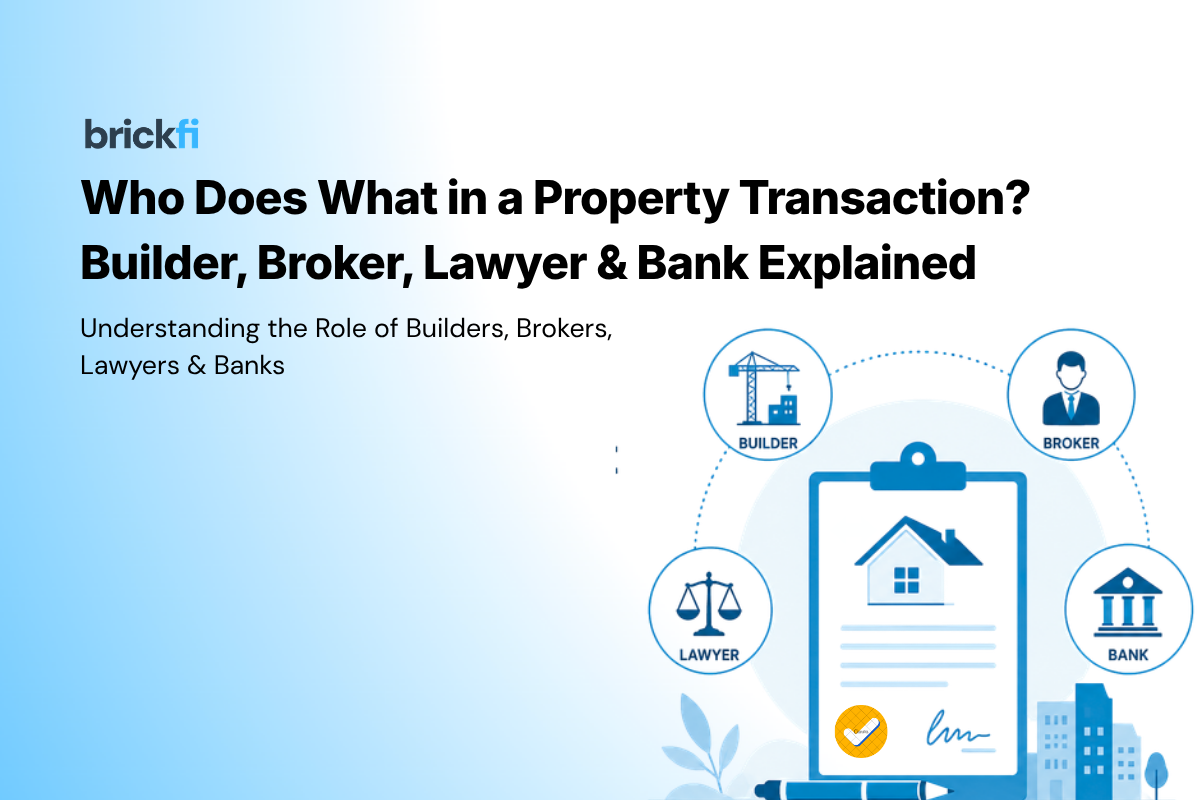
A builder, broker, lawyer and bank can all play valuable roles in a property transaction, but they are not interchangeable. The builder explains and sells the project. The broker helps facilitate the purchase. The lawyer protects your legal interests. The bank determines whether and how it will finance the transaction.
The buyer still needs an independent view of the overall decision.
At Brickfi, that is where we try to make the buying process more informed. Brick360 helps buyers examine factors such as builder history, project layout, surroundings, pricing and growth potential using verified government and public data, while Brickfi Assist provides buyer focused guidance through the home buying journey.
The goal is not to replace your lawyer, bank or other specialists. It is to make sure you understand the property well enough to ask each of them better questions.
FAQs: Property Buying Process Bangalore
1. Who handles a property transaction in Bangalore?
Different parties handle different stages. The builder or seller handles the property sale, brokers may assist with discovery and negotiation, lawyers conduct legal verification, and banks manage home loan related assessments. The buyer coordinates the overall decision.
2. Who checks property documents before buying?
A property lawyer appointed by the buyer can conduct independent legal verification. The documents required depend on the type of property but may include title records, Encumbrance Certificates, Khata related records, approvals, tax receipts and transaction agreements.
3. Do you need a lawyer to buy property in Bangalore?
Independent legal verification is advisable for a major property purchase. A lawyer can examine ownership and property documents and review important contractual terms before you make substantial financial commitments.
4. Is bank approval enough to know that a property is safe to buy?
No. Bank approval provides an additional layer of legal and technical assessment for lending purposes, but it does not replace the buyer’s own legal, commercial and financial due diligence.
5. Who pays the broker, lawyer, stamp duty and registration charges?
The buyer generally bears applicable stamp duty and registration charges and pays a lawyer appointed independently. Brokerage depends on the transaction structure and may be paid by the buyer, seller, developer or a combination based on the agreed arrangement.
Get instant access to expert, data-driven property insights.
Request your free Brickfi investment report now and make smarter real estate decisions today.