
Fixed vs Floating Home Loan Rate in 2026: What Should You Choose Right Now?
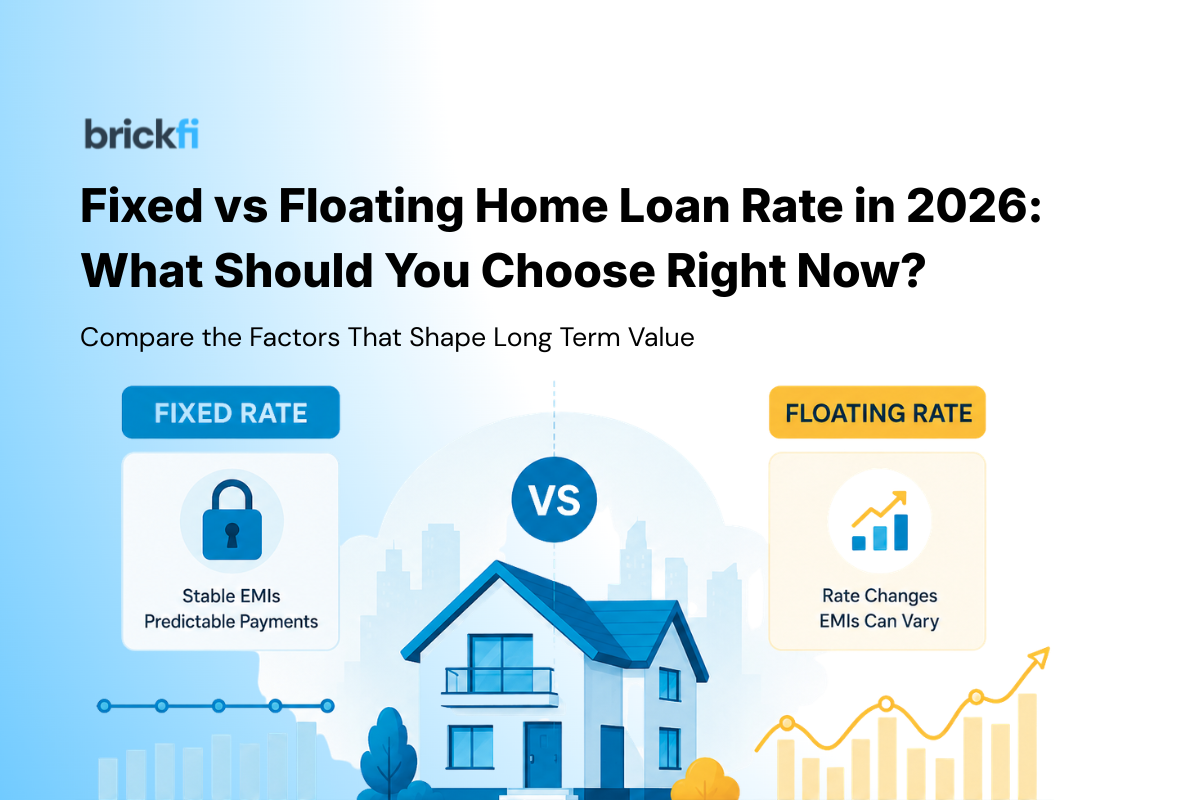
Overview: Fixes vs Floating Home Loan
Choosing a home loan is not just about finding the lowest interest rate. It is about choosing the right type of rate structure that fits your financial situation.
In 2026, borrowers are often confused between fixed and floating interest rates. With repo rate movements, changing bank policies, and different loan structures like MCLR and repo-linked rates, the decision has become more complex than before.
While both options have their advantages, the right choice depends on your risk tolerance, income stability, and view of how interest rates may move in the future.
This guide breaks down fixed and floating home loan rates in a clear, practical way so you can make a confident decision.
Key Takeaways
- Fixed rates offer stability but are usually higher than floating rates
- Floating rates change with market conditions and RBI policy
- Most loans in 2026 are repo rate linked
- Floating rates can reduce cost over time but come with uncertainty
- The right choice depends on your comfort with risk and cash flow
Understanding Fixed vs Floating Home Loan Rates
A fixed home loan interest rate remains constant for a defined period, regardless of market changes. Your EMI stays the same, which provides predictability.
A floating interest rate home loan changes based on external benchmarks such as the RBI repo rate. When rates go down, your EMI or tenure reduces. When rates go up, your cost increases.
In simple terms:
- Fixed rate = stability
- Floating rate = flexibility
Get instant access to expert, data-driven property insights.
Request your free Brickfi investment report now and make smarter real estate decisions today.
What Is a Repo Rate Linked Home Loan?
Most home loans today are linked to the RBI repo rate. A repo rate linked home loan means your interest rate moves directly with changes in the repo rate set by the Reserve Bank of India.
For example:
- If RBI reduces repo rate- your loan interest decreases
- If RBI increases repo rate- your loan interest increases
Compared to older systems like MCLR, repo-linked loans are more transparent and respond faster to market changes.
Repo Rate Linked vs MCLR: What Has Changed
Earlier, banks used the MCLR (Marginal Cost of Funds based Lending Rate) system. The shift to repo-linked rates has changed how quickly borrowers feel the impact of rate changes.
- MCLR-based loans adjust slowly
- Repo-linked loans adjust faster and more directly
This means borrowers today experience quicker changes in EMI or tenure when interest rates move.
Fixed Home Loan Rates: When Do They Make Sense?
Fixed rates are typically higher than floating rates, but they offer stability.
They make sense when:
- You want predictable EMIs
- You prefer financial certainty over cost savings
- You expect interest rates to rise in the future
However, most fixed-rate loans are not truly fixed for the entire tenure. Many banks offer fixed rates only for a limited period, after which they switch to floating. This is an important detail buyers often overlook.
Get instant access to expert, data-driven property insights.
Request your free Brickfi investment report now and make smarter real estate decisions today.
Floating Home Loan Rates: When Are They Better?
Floating rates are generally lower than fixed rates and can reduce your overall interest cost over time. They are more suitable when:
- You are comfortable with some fluctuation in EMI
- You have stable income and financial flexibility
- You believe interest rates may stabilise or reduce in the long term
In India, over long periods, floating rates have often resulted in lower total interest outflow compared to fixed rates.
Cost Impact Over Time
The difference between fixed and floating rates becomes more visible over the long term. A slightly higher fixed rate may increase your total repayment significantly over 15–20 year period. On the other hand, floating rates may fluctuate but often average out lower over time.
However, this comes with uncertainty. You need to be financially prepared for periods when rates increase. This is where risk tolerance plays a key role.
A Practical Way to Decide
Instead of trying to predict the market perfectly, focus on your financial position.
Choose fixed rate if:
- You prioritise stability and predictability
- Your budget is tight and cannot absorb EMI increases
Choose floating rate if:
- You want to optimise long-term cost
- You can handle short-term fluctuations
- You have flexibility in your cash flow
Many borrowers today prefer floating rates because they align better with long-term cost efficiency.
Get instant access to expert, data-driven property insights.
Request your free Brickfi investment report now and make smarter real estate decisions today.
A Common Borrower Mistake
One of the most common mistakes is choosing a loan based purely on the lowest home loan interest rate at the time of application.
Borrowers often ignore:
- How the rate may change over time
- Whether the loan is repo-linked or MCLR-based
- How much flexibility they actually have in their budget
This leads to surprises later when EMIs increase. A better approach is to evaluate both current rates and future scenarios.
How Brickfi Helps You Choose Better
Understanding interest rate structures can be confusing, especially with multiple options available across banks.
Brickfi helps simplify this by comparing loan structures, not just rates. This includes evaluating how fixed and floating rates impact long-term cost, EMI stability, and financial planning.
Instead of focusing only on the lowest rate, the goal is to help you choose the structure that aligns with your financial comfort and long-term goals.
Get instant access to expert, data-driven property insights.
Request your free Brickfi investment report now and make smarter real estate decisions today.
Final Thoughts
The decision between fixed and floating home loan rates is not about choosing the “better” option, but about choosing the one that fits your financial situation.
Fixed rates offer peace of mind but come at a higher cost. Floating rates offer flexibility and potential savings but require comfort with uncertainty.
In 2026, with repo-linked loans becoming the standard, most borrowers are leaning toward floating rates. However, the right decision still depends on your risk tolerance, income stability, and ability to manage changing EMIs.
When you focus on alignment instead of prediction, the choice becomes much clearer.
FAQs: Fixed vs Floating Home Loan
What is the lowest home loan interest rate in 2026?
Rates vary by bank and borrower profile, but floating rates are generally lower than fixed rates.
What is a repo rate linked home loan?
It is a loan where the interest rate is directly linked to the RBI repo rate and changes accordingly.
Is fixed or floating home loan better?
Floating rates are usually better for long-term savings, while fixed rates are better for stability.
What is the difference between repo rate and MCLR?
Repo rate is set by RBI and affects loans directly, while MCLR is bank-controlled and adjusts more slowly.
Should I switch from fixed to floating rate?
It depends on your loan terms and market conditions, but many borrowers consider switching when floating rates are significantly lower.
Get instant access to expert, data-driven property insights.
Request your free Brickfi investment report now and make smarter real estate decisions today.